research
Research themes and selected projects.
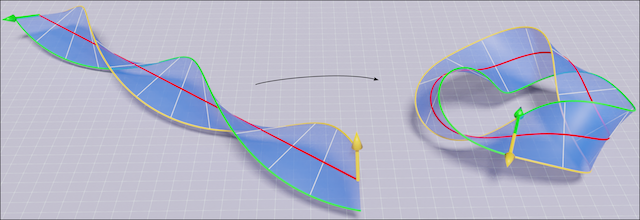
Isometric folding of helicoids into Mobius bands
In this work, we ask when an unstretchable circular helicoid can fold into a Mobius band without changing its metric. We reduce the surface geometry to conditions on the band midline and its frame, then use those conditions to design helicoid templates. The construction gives stable Mobius bands with prescribed odd numbers of half twists.
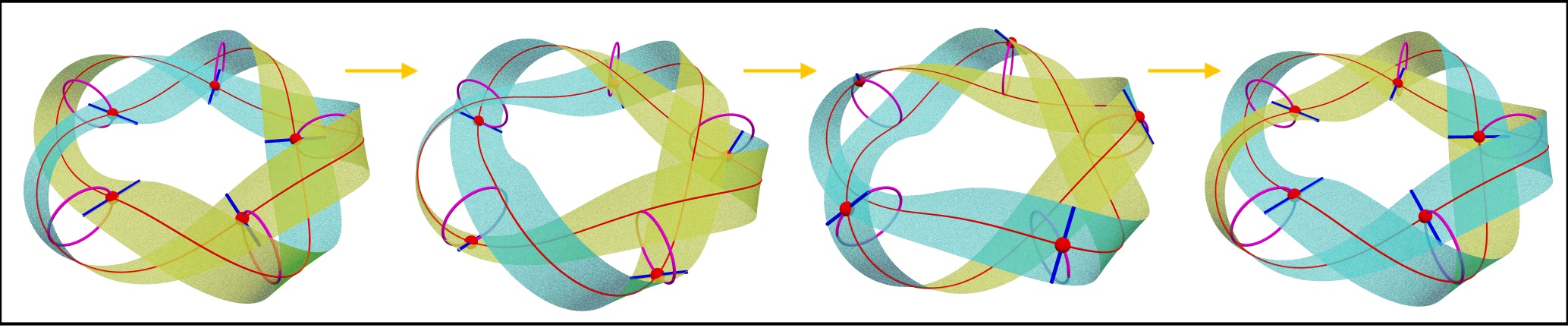
Everting motions of Mobius and orientable bands
In this project, we construct continuous eversion paths for Mobius and orientable binormal scrolls while preserving metric and bending energy. We track the full motion, not just the starting and ending shapes. The examples connect classical curve geometry with foldable, shape-changing structures.
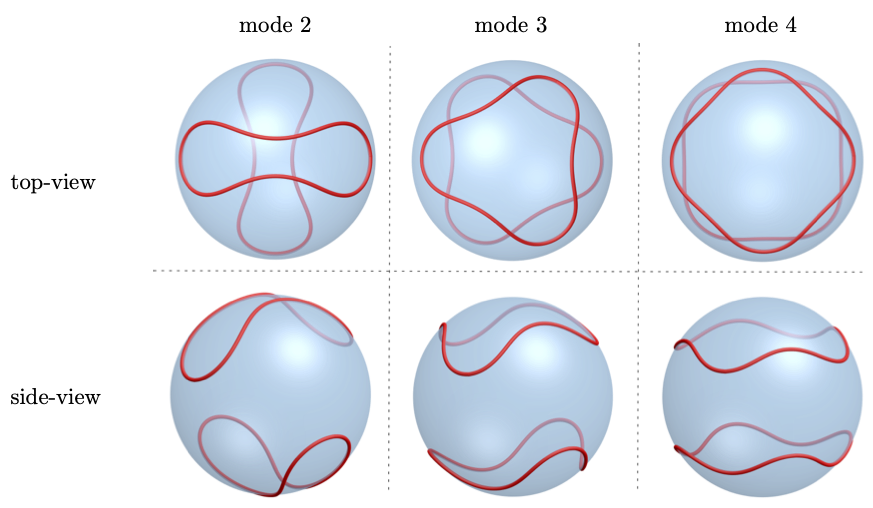
Charged elastic loops on a sphere
In this work, we formulate the equilibrium problem for charged elastic loops constrained to lie on a sphere. We balance bending energy with intra-loop and inter-loop electrostatic interactions. We then analyze how loop length and charge density select unstable modes and equilibrium shapes.
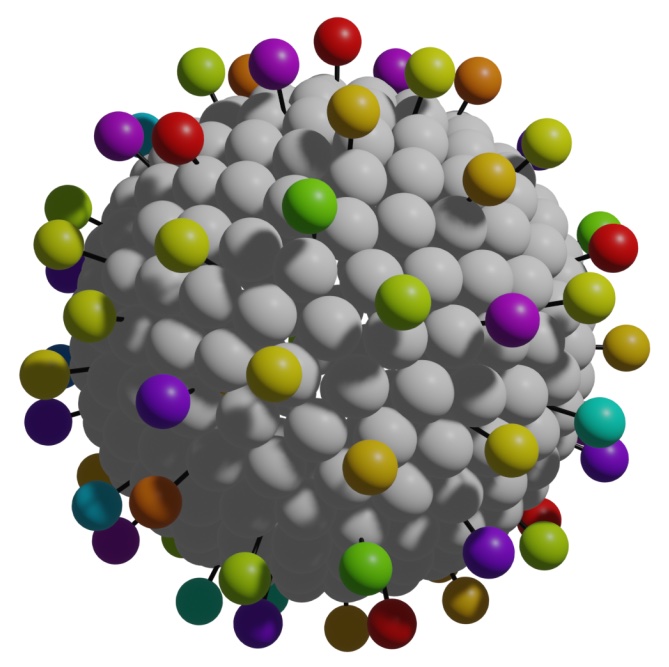
Virus-shape modeling and hydrodynamics
For these projects, we represented virus particles as rigid cores decorated with rigid bead-rod spike proteins, then minimized interaction energies to obtain particle shapes.
- Charge heterogeneity: how nonuniform spike charges alter spike arrangements and hydrodynamic response.
- Spike shape: how triangular spike geometry changes particle shape and transport properties.
- Pleomorphism: how spherical, prolate, and oblate cores change virus-particle hydrodynamics.

Surface tension imbalance
In this project, we analyzed partly submerged bodies separating surfactant-laden and surfactant-free liquid interfaces. We quantified how surface tension imbalance changes vertical support and creates horizontal forces. The same mechanics appears in Marangoni propulsion and surface-pressure measurement.
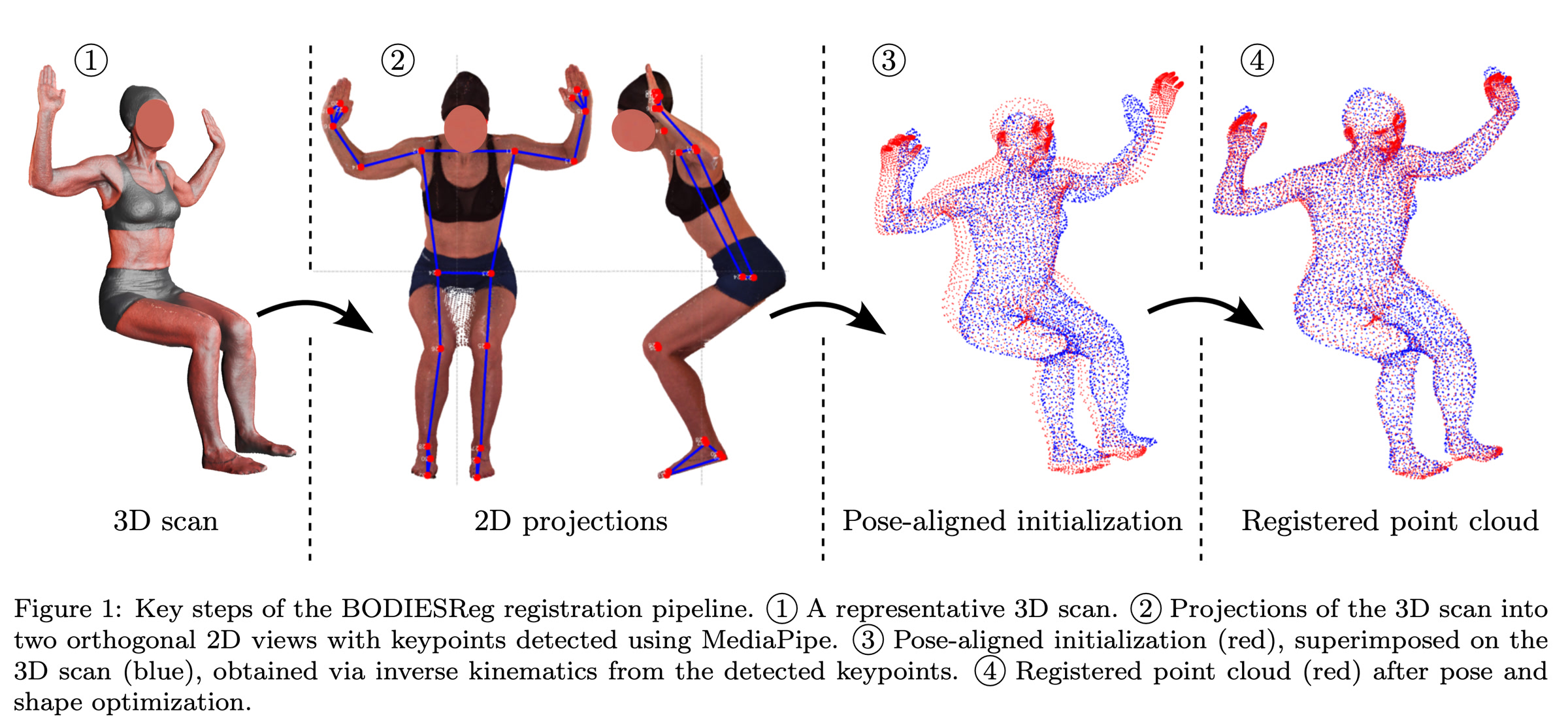
BODIESReg for 3D body-scan registration
BODIESReg is an open-source pipeline for registering 3D body scans to parametric body models. We estimate the scan pose before surface fitting, so the optimizer starts from a pose-aligned mesh rather than a default template pose. The pipeline runs end-to-end in automatic mode, supports batch processing, and includes interactive tools for difficult scans.
- Targets biomechanical model personalization from 3D body surface scans.
- Uses pose-aligned initialization before Chamfer-distance minimization.
- Achieved mean surface-fit errors below 10 mm for successful registrations.